Friday, June 21, 2019

Spark

In the spirit of my extremely occasional posts on here about apps I've downloaded, a few months ago I downloaded an app called Spark. In short, it's a text-based game that requires you, a single-celled organism, to build as much influence as you can through exploiting the resources Matter, Energy, Structure, Time, Space and Spirit. The resources double, triple or more in value when you spend influence to amass them, and you also gain knowledge that carries forward each time you destroy the universe.

Along your spark's journey to mastery, there are Evolutions. Intelligence, Consciousness, Purpose, Nebulae, Star Formation, and so on lead you to greatness.

The Spark Wiki explains the app at least as well as I can:
Spark is an Idle game that was both developed and published by Deuski Games. In Spark, you take on the role of a Spark of Life that suddenly pops into existence and begins to blindly accumulate Matter into itself, thereby growing its influence on the Cosmos. The gameplay of Spark is in the classic style of idle games, where the user interface consists solely of buttons, progress bars, and timers. The game begins as simply as possible, with only one Resource (Matter) available to you, but you will quickly be prompted to swipe left to the Evolution page, where permanent improvements can be unlocked, which include more resources, auto-incrementing (even while the app is closed), an additional Upgrades menu, a reset mechanic, and more! The goal of the game is to amass as much Influence as possible and build the Cosmos in your own image!
The Wiki contains sections on most of the app's major functions, such as the aforementioned Resources, Upgrades, Evolutions, Universe Destruction, and Knowledge.

Spark has a special feature called Epochal Moments. They occur due to total influence acquired over the life of the game, meaning spending influence on upgrades does not affect when they occur. These Epochal Moments also make the game even more science fiction than it already sounds.

For fans of Spark, or for those seriously considering playing, here is the full list of Epochal Moments, which I transcribed during a GO train ride:
You exist. You are not aware that you exist because you are not aware. Instinctively, you draw nearby particulate matter to yourself. You synthesize it, and your influence begins to grow. 
You gather more matter to yourself, and you begin to do so more efficiently. The more influence you obtain, the more complex you become, and the quicker you grow. 
The patterns within you grow ever more complex, loops within loops. They blend and meld into one another. As the biggest and most complex of the systems envelops the others, you experience your first thought: “I am”. 
As your influence grows, a voice reaches into your thoughts. It suggests you heed the wisdom of those who came before you. 
Your influences grows without bound, yet you feel increasingly adrift. You reach out to the space around you and begin to organize; stars, planets, and galaxies form., and though all you see is good, you do not feel satisfied. 
As you drift through the cosmos, you notice one planet among billions that is covered in strange molecules, more complex and more varied than you have seen before. They have no Spark, no life, but nevertheless you take special watch of this planet as the eons creep by. 
Upon barren rocks patterns begin to take form. Small at first they grow more numerous and more intricate; some fall by the wayside while others grow ever larger in the slow unconquerable process of evolution, guided by your hand. 
You find the individual cells grow faster when they band together as a single unit. Over countless eons they specialize and change until none can survive isolated from the others. 
After eons of painstaking incremental change, the life you have created and nurtured experiences its first taste of self-awareness. Consciousness at long last has been given physical form. 
The conscious life you have created takes its first cautious steps out of infancy. It learns and adapts to its surroundings at a rate that has never been seen before as the individuals teach themselves to craft tools and pass that information across generations. 
The life you have created expands and builds great societies as this world has never before known. They craft ever more impressive machines, they wage war, they look out and ponder, and they continue to grow. 
The life you have created is not content to be confined to the planet it was born on. Though tentative at first, the species begins to leave on shuttles of their own design and populate other worlds. 
The life you have nurtured for so long travels and colonizes other worlds. Occasionally they meet others that are like themselves. They share technology and history, and learn from one another. The petty wars that plagued their past are now a distant memory. You look upon them and are pleased. 
Conscious life spreads rapidly throughout the Cosmos, building an astounding society that spans galaxies. Their technology continues to improve, each individual now has power that would have had them considered a god in previous eras. You watch as they continue to expand. 
The conscious life grows ever more introspective even as it continues to expand. Their understanding of the Cosmos is unparalleled, but they still marvel at why they exist, and wonder what could be their purpose. In the back of their minds they mull over this question and continue to expand. 
The conscious life, these sapiens, realize they cannot be bound to their forms forever. Like all things physical, their bodies will begin to decay. The brightest among them will gather together, and begin to work on a solution. 
The life you have created has devised a way to shed their physical form; all at once they leave their plane and join as one, a being not unlike yourself, though it is a mere shade compared to your current form. You craft a universe in which it can dwell. It instinctively reaches out and its influence begins to grow. 
These new, more intelligent beings form tightly knit packs, and they are capable of organizing and communicating commands more complex than any of their ancestors. Though the accomplishment is great, their minds are still not in your image; they are incapable of self-reflection. 
The life continues to fill the many niches present in the planet, and the simple presence of life creates new niches that are then filled by new organisms that would never have been possible in the earlier days of this wondrous experiment. 
The Great Societies of these sapient beings have grown powerful enough to destroy their world many times over. Tension fills the hearts and minds of every one of the planet’s inhabitants, and though they may be on the brink of self-extinction, they continue with their lives and continue to grow. 
The beings have reconciled with each other, and have formed a unified society that is no longer beholden to the boundaries of the past. Their resources are plentiful, and as their understanding of their place in the Cosmos continues to grow, they begin to look at the stars. 
A vast and wonderful variety of life now populates the planet you came to all those ages ago. Anywhere it is possible to survive, something finds a way to do it. Some of the life sustains itself from the energy of the nearby star, others live by consuming that life while avoiding being consumed by others. The pressure to survive continually pushes these creatures to adapt and change, and many among them grow ever more complex. 
In the struggle to survive, new strategies emerge. Creatures dart and dodge, outsmarting would-be predators. Their intelligence increases, and though the energy demands of larger brains are great, the ability to synthesize and react to new information ensures their survival. You grow vested in these creatures and begin to guide their evolution, cultivating their mental abilities.
Weird fact about the above: all 23 Epochal Moments combine to equal exactly 975 words. If there's an under 1,000 word transcription contest out there focusing on intergalactic apps, this has to win.

Thoughts on this version of how the universe progresses?

Thursday, June 20, 2019

A Timeline of a Norwegian Town's Lack of Time

If you've been following Norwegian clock news lately, surely, you've encountered one northern Norwegian man's quest to abolish time. His town is enamored with the idea, and now it's apparently being tabled - less than two days after his proposal made international news. For a group of people opposed to living life by the clock, this is awfully fast.

June 18, 3:42PM EST (8:42PM GMT): 'Don't let the clock lead us,' says Norwegian man seeking to abolish time -National Post


The progression in the titles from these outlets is astounding. From one inspiring man, to wanting to abolish time, to campaigning for it, to apparently having abolished it in the past tense (the Guardian article mentions an upcoming vote, though).

The gist of the time abolition campaign is in two key paragraphs of the Post article above:
Time also passes slowly in the Arctic Ocean, off the northern coast of Norway, when you are floating on a small boat under the bright evening sun, which is where the National Post on Monday reached Kjell Ove Hveding, a retired businessman who is actively working to abolish time in his home town of Sommaroy, a little fishing village of 300 souls. [The Guardian article above places the population at 350 and places the slash in the second O of Sommarøy.]
...
Stores will open when the staff is there, and close at other times. Schools will be flexible. Deadlines will be negotiable. Restaurant reservations will be tricky to manage, but tourists will be encouraged to move at their own pace. Importantly, there will be no clocks. Already, a poignant tribute of abandoned watches has spontaneously appeared on the railing of a local bridge.
For what seems so simple (think of any time you've been in a shower or bath on a weekend and lost track of time), it's so multi-layered:

  • Timing everything is a product of the Industrial Revolution. However, sunrise and sunset were key determinants of time in pre-Industrial societies. In northern Norway, as Hveding notes, light and darkness are seasonal. Here, according to the Sky News article above, "Sommaroy, north of the Arctic Circle, experiences a period of 69 days every year when the sun doesn't set - and this, according to the locals, is why the area should be considered a time-free zone."
  • This initiative is largely based on the idea that people are too attached to time, and should therefore break free from it. This would presumably lower stress levels. According to the Guardian article above, "In many cases this [stress and depression] can be linked to the feeling of being trapped by the clock."
The idea is admirable. However, I've already identified a few problems:
  • Stores only being open when staff are there works fine in a localized area, where walking home only to try to go to the store again in a couple hours can be workable. How can this concept ever be ported to a larger geographical area, though? That half-hour drive to Costco suddenly makes a lot less sense when Costco could be arbitrarily closed.
  • Although I eat when I'm hungry most days anyway, eating only when you're hungry could lead to substantially fewer family dinners or, similarly, meals out with friends. Alternatively, there's the risk of showing up and being the only one who's really hungry.
  • Abandoning clocks and watches must presumably also mean abandoning other timers. Otherwise, people would have the ability to tell time, which defeats the psychological purpose of living outside of time.
    • Abandoning stopwatches eliminates any chance that residents of Sommarøy ever had at being competitive in the 100-metre dash.
    • Abandoning oven timers reverts residents to the older "cook until done" model.
    • Microwaves would all have to have their timers blacked out, possibly by such low-tech means as placing duct tape or electrical tape over the timer. Toaster ovens, which usually require turning the knob to a set time, would be unworkable.
    • Sports would all have to be played to a set number of points, or be played in innings like baseball. One can only guess what would happen to basketball's shot clock.

I'd love to visit a place without time for a week or so. Should I instead visit until I feel like leaving?

Monday, May 27, 2019

May's Book: Somewhere in Time

Somewhere in Time* by Richard Matheson
Speculative Fiction (1980** - 316 pp.)

Somewhere in Time stars Richard Collier (1935-1971), who bears a faint resemblance to the author, on a road trip in Southern California at the seeming end of his thirty-six-year-old life. At the Coronado Hotel, he discovers a picture on the wall, from 1896, of stage actress Elise McKenna (1867-1953) - and he instantly falls in love. Her mother and manager are understandably shocked by these events, although McKenna immediately tells Collier she was expecting him. Impossibly, can Collier and McKenna be together? The answer, as those familiar with Matheson might figure, is "sort of". The beginning and end are written by Collier's brother Robert, commenting on Collier's rushed manuscript, calling it a brain tumor-induced delusion and making editorial remarks along the way. Did this story even happen? Somewhere in Time is the first Richard Matheson book I've reviewed since I Am Legend in 2013

On the road in California in 1971, Somewhere in Time starts in an extremely choppy writing style. The first couple sentences of Collier's narrative are "Driving down Long Valley Road. Lovely day; bright sunshine, blue sky." (15) Matheson's writing flows better from approximately page 67 onward, which isn't a particularly important page. However, the writing is denser and more modernist in 1896, and verging on postmodern in 1971, as a general rule.

In preparation for 1896, Collier purchases a $20 gold certificate with a picture of James Garfield on it, and a $10 gold certificate with a picture of Thomas A. Hendricks on it. I had never seen a $20 gold certificate before, or a $10 gold certificate. There's irony here too: Richard Matheson clearly knew who Thomas A. Hendricks was, but Richard Collier does not.*** Matheson must have been prophetic. He states that "the man in the shop knew of an available twenty-dollar gold certificate that had never been circulated and I was tempted to buy it until he told me it would cost about six hundred dollars", (104) and, lo and behold, there is currently a $20 gold certificate from 1882 available for $595 USD on eBay. (stable link)

Matheson's penchant for one-liners is back in full force. When Collier is researching 1896, from clothing to currency, so he can be prepared for his journey, he notes: "Here's a contradiction. Research always turns them up, I guess." (53) When Collier wakes up in 1896 for the first time, the opening line is, "I opened my eyes to see the fire of sunset on the walls and ceiling." (117)

When 1896 arrives, the world is altered to a granular level, such as when he refers to the use of brandy to treat heart attacks. (122) Harvard still gives a highly limited endorsement of this practice, tying it to moderate drinking and heart health generally. Less surprising is how one of the first sights that sinks into Collier's mind is the lack of a parking lot. When Collier reads the newspaper, he is astonished by how little people change; one of the top stories, for example, is a murder. It's the lack of a parking lot that gets him, and I think, if I ever travel back to 1896, that sort of thing will get me too.

McKenna's manager William Fawcett Robinson emerges as an antagonist, whether due to his own designs on McKenna or due to his extreme dislike of Collier having simply appeared out of nowhere as McKenna's suitors. Collier and Robinson's conflict leads to another of Matheson's great one-liners: "For now, though, can we call a truce? I'm just not up to anything else." (179) Anyone who's worked a busy job and also had a social or family conflict can identify. Robinson will eventually die on the Lusitania, which Collier discovers in his research and then mentions frequently. (47) Imagine the look on Robinson's face when, in a bout of rage, Collier tells him this. In a reference Collier could make without muddling history, Collier reminds himself of Peyton Farquhart from Ambrose Bierce's "An Occurrence at Owl Creek Bridge", although Collier doesn't yet meet his fate. (141)

One sneaking suspicion I had throughout the book was: what happens in 1935? The year of Collier's birth hangs ominously over the story. Surely there can't be two simultaneous Colliers. Does the 1896 version have to assume a new identity? Or is he destined to perish before 1935, which inevitably also means predeceasing McKenna? Collier eventually considers exactly this and, understandably, considers it too horrible to ponder. (187)

As tempting as it is to say the plot is simply too melodramatic and far-fetched, Matheson plays it straight perfectly. McKenna's stage play is written as though Matheson had written the entire screenplay and then excerpted it. The play has an 1,001 Arabian Nights feel; Robert is relaying Collier to the reader, and then Collier relays the play. Only the abduction side plot in the main book is disappointing (I can't go into greater detail without spoiling a substantial portion of the book), and even then, only because it adds another layer of plot. Time travel, romance and performing arts are enough to carry Somewhere in Time, and for approximately 300 out of the book's 316 pages, they do. The abduction side plot, however well written, doesn't carry the book. It also has some numerical issues, like how Collier says he was born in 1936 (he was actually born in 1935) and was nineteen in 1953 (he was eighteen, and couldn't be nineteen whether he was born in 1935 or 1936). (258-259) Finally, Collier's unfortunate encounter with a blackjack (266) is simply not how unconsciousness works. Unconsciousness typically only lasts a few seconds, or else it becomes a full-blown coma. On the plus side, I may have to start using the phrase "deader than a mackerel" (262) in daily life.

Now that I've gone to such pains to avoid spoilers, here's an anti-spoiler. Somewhere in Time lacks a table of contents for a reason. The chapters are all named after their respective dates, The Sound and the Fury-style. Those dates include years. Please, dear reader, do not flip ahead to discover upcoming chapter names. It will not bode you well.

Yes, it's impossible to read this book without having the title track from Iron Maiden's Somewhere in Time (1986) stuck in your head the whole time. I can only imagine Iron Maiden was thinking of this book when they named the album. Fittingly, when McKenna worries about losing Collier, she says she feels "locked inside an iron maiden." (298)

Is there, somewhere back in time, a place where we can cheat death and fall in love? Richard Collier thought so.

Ease of Reading: 8
Educational Content: 2

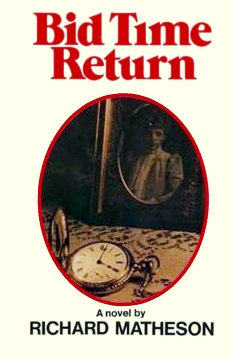
*This book was originally published as Bid Time Return (1975). It received an apparently immediate title change after the release of the 1980 movie starring Christopher Reeve and Jane Seymour. I haven't seen that movie, although now I feel like I should.

**Although Somewhere in Time came out in 1980 under that title, it can be considered finished far earlier due to Bid Time Return's 1975 release date. Bid Time Return's original 1975 cover shows Richard Collier, whereas the cover of the edition of Somewhere in Time I read shows Elise McKenna. Each cover shows a stopwatch.

***A note on tense, especially considering the book's time travel narrative: Richard Matheson can only know things in the past tense, sadly, whereas the fictional character Richard Collier can never die.

Sunday, April 28, 2019

Bonus Book! Valis

Valis by Philip K. Dick
Science Fiction (1981 - 241 pp.)
For two thousand years the single rational element in the world had slumbered. In 1945 it woke up... (112)
In Valis, Philip K. Dick moves away from fabricated quasi-humans and alternate post-World War II reality to tell a story about... a protagonist with his own name having a series of out-of-body experiences, all set against the backdrop of Cold War-era California. The lack of Replicants or arms races is barely noticeable, as Valis is such a twisting story it could only have been written by Dick. It follows Horselover Fat, who is also a fictionalized Philip K. Dick, through failed relationships, a near suicide, and a journey with his friends to discover the meaning of life, all set in the 1970s.

Everything in Valis is rational to a horrifying extent. Fat's girlfriend Gloria is insane because it behooves her to be insane: "Gloria's mind had total control over her body; she was rationally insane." (11) Dick digs back into his The Man in the High Castle-era Sinophilia, using the I Ching as a reference point, as well as Yin and Yang to represent the balance in Fat's world. (239) Dick references Chinese fingertraps throughout, showing how the characters are trapped into their situations by the only events that could logically occur. On Fat's growing realization of his building sanity, "Let it be said that one of the first symptoms of psychosis is that the person feels perhaps he is becoming psychotic. It is another Chinese fingertrap. You cannot think about it without becoming part of it." (17) Dick is Fat, and Fat is Dick, but Dick sees Fat from a third-party bystander's perspective. Fat's version of his psychosis is, understandably, far more favourable to him: "I am illuminated by holy light fired at me from another world. I see what no other man sees." (30) That sentence may be the thesis, if Valis could ever have just one.

If Fat is insane, he certainly has a difficult time of his brief sojourn in a mental institution. Dick portrays mental institutions as places where nothing happens, (54) yet immediately presents the reader with a cruel paradox: prefrontal lobotomies are available only to those patients who consent to them. (57) Given the difficulty of informed consent to psychosurgery, Fat appears to have landed in a One Flew Over the Cuckoo's Nest-style situation, in which Ken Kesey describes a draconian mental institution based on his own experiences. Fat is alarmed at nothing, though, and instead sees his institution as a place where he could get better: "Dr. Stone wasn't insane; Stone was a healer. He held down the right job." (65) He doesn't, but it's not because he doesn't try. Dr. Stone and the other staff appear legitimately helpful, though, avoiding a situation like "The System of Dr. Tarr and Professor Fether". At least, Dick/Fat leads the reader to believe this.

Media before, in and after Valis are crucial to the reader's experience. The title is taken for Vast Active Living Intelligence System, a device used in a movie, also called Valis, the characters watch. (139-144) Watching Valis, Fat realizes the movie tells the story of his own life, which causes him and his friends to reach out to the movie's makers. Naturally, for Dick at least, this results in Fat likely writing a series of letters to his past self, "All You Zombies"-style. The closest comparison is if, in A Midsummer Night's Dream, the play-within-a-play starred Hippolyta and Puck. Looking forward, 1990s media has some Valis in it. The disembodied protagonist watching his own life is played up even farther in Martin Amis's Time's Arrow. Fat's visions could easily be an influence on Tool, of Los Angeles alternative metal fame. Fat is able to see using his third eye. (116, 230) When a third self emerges, the mercurial Zebra, everything doubles back on itself: "On some level Fat guessed the truth; he had encountered his past selves and his future selves - two future selves; an early-on one, the three-eyed people, and then Zebra, who is discorporate." (120)

When Fat meets Valis's makers, he comes to understand the true nature of reality. Yes, telling you exactly what Fat discovers would be a spoiler, although it involves a movie producer who calls himself Mother Goose and a virtually omniscient two-year-old named Sophia. These bizarre encounters lead to a series of epigrams about salvation, which rank among Dick's all-time great one-liners. After nearly dying a few times, Fat feels far greater urgency: "You always need the Savior now. Later is always too late." (213) Sophia appears to Fat in a dream that convinces him she is able to use dreams to communicate; in the dream, her description borders on Biblical: "The dark eyes filled with light and life and fire." (215) Tying together the otherworldliness of it all combined with Fat's growing need to uncover life's mysteries, Fat realizes that for all his rationality, he has extremely little control: "The divine intrudes where you least expect it." (228)

Valis is from the Cold War, in both release date and setting, which means the USSR persists. This is fine for the 1970s, but the book opens with a fake dictionary entry for VALIS. The dictionary, of course, is "Great Soviet Dictionary Sixth Edition, 1992". Not to worry - the USSR fell less than a year earlier. In Burning Chrome, William Gibson has communists in the 2300s.

Ease of Reading: 4
Educational Content: 3

Thursday, April 11, 2019

April's Book: Throne of Jade

Throne of Jade by Naomi Novik
Fantasy (2007 - 398 pp.)

Throne of Jade is the second book in Naomi Novik's epic Temeraire series, starring Napoleonic-era Royal Navy Captain Will Laurence and his trusty dragon Temeraire. In the first book, His Majesty's Dragon, Laurence captures a French ship carrying priceless cargo from China: a dragon egg, from which sprouts our lovable living tank Temeraire. In Throne of Jade, a Chinese prince demands Temeraire be returned to China, leading Laurence and crew on a perilous voyage in which a Chinese prince threatens to separate our two main characters. Throne of Jade takes place in 1806, in the aftermath of Trafalgar and Austerlitz (163-164), at a time when Napoleon was becoming weaker at sea while stronger on land. The British, though, control the air.

The voyage leads the Allegiance and its crew, headed by Laurence, past Madeira, the Cape of Good Hope, and what is now Indonesia, to its destination at Macao. The intervening cultures are little discussed except that they provide a true transition from a European to an Asian setting. The characters' behaviours follow suit. One of the first joint English-Chinese dinners on board is a suckling pig (141-142), whereas later on Temeraire discovers his love for highly spiced Chinese and Southeast Asian food. Laurence bemoans the frequent sullying of his military uniform, which is inevitable considering the sheer frequency of battle scenes in Throne of Jade (approximately one every twenty pages), yet he is relieved when he finds his new Chinese clothes cleaner than anything he had worn in months. Still, Laurence cannot accept the presence of so much bribery in Chinese markets (315), nor can he go any farther than bow to the Emperor. (270-271)

Temeraire is a pet of sorts, but it's tough to call him a true pet when he understands poetry better than the highly educated Laurence, has a charming British wit, and is capable of sinking entire warships by himself. Temeraire is more of a familiar spirit, specifically a divinatory animal, which fits perfectly with historical British mythology and with the importance of dragons in Chinese culture. He therefore ends up as an outsider wherever he goes, equally frustrated by the lack of women in the British armed forces despite the gender-blind military purposing of dragons and his inability to write before the dragons in China show him how. When Laurence explains female dragon aviators being the only English women allowed to serve, Temeraire notes that "I do not understand in the least, why ought it make any difference at all? Lily is female, and she can fight as well as I can, or almost". (205) Upon hearing a poem composed by a Chinese dragon, Temeraire laments that "I might like to try, but I do not see how I would ever put it down; I do not think I could hold a pen." (145) Above all, Temeraire's loyalty to Laurence is both British military camaraderie and Chinese filial piety; Temeraire is at once Laurence's army buddy and his son.*

As with His Majesty's Dragon, another high point is how realistically Throne of Jade presents the characters' surroundings. Novik has clearly researched the period, down to the characters' wording choices and clothing. Although a book starring a talking dragon is clearly not meant to be realistic, Novik suspends the reader's disbelief on the dragon point well, and keeps the rest Earthly.** When the heroes are still yet to embark, a European dragon battle happens, yet with the humans using realistic Napoleonic-era guns. (102-103) Likewise, what should have been a wholly unrealistic fight scene on deck during a storm ends up becoming a gripping description of the wind, clouds, mist and fog that decide Laurence's fate. (231) The Scientific American article linked earlier in this paragraph applies to the experience of reading the series:
Being transported emotionally into an alternative reality helps us to invest more completely in a piece of fiction, no matter how unbelievable.
As with fantasy novels in general, Throne of Jade could have used some reining in on the third-person omniscient narrator's commentary. If I had a PDF of Throne of Jade, I could Ctrl+F the word "almost" and probably find dozens of extraneous examples, such as "Her hand tightened almost painfully on his arm" (12) - why not just "Her hand tightened painfully on his arm"? or even "Her hand tightened on his arm"? Novik uses the word "only" much the same way, as in "He turned only reluctantly" (10) - why not just "He turned reluctantly"? A proverbially thorough thinning of the adjective and adverb soup would have been useful here. That's on the editor(s) more than Novik.

I read His Majesty's Dragon back in February 2016 - although I had 29 days to read it - and found Throne of Jade an appendage rather than a separate story. I therefore had to spend much of the first 50 or so pages reminding myself who all the characters are, making Throne of Jade a nearly impossible read for someone who hasn't read His Majesty's Dragon.*** For example, Catherine Harcourt and Admiral Lenton, two characters from His Majesty's Dragon, rarely appear in Throne of Jade but are mentioned semi-frequently by both Laurence and Temeraire. (190) Novik's books are so widely available, and such quick reads, this shouldn't be a major issue. Someone interested in Napoleonic-era British captains and their dragons should simply read the books in order.

Ease of Reading: 9
Educational Content: 2

*This has potentially awkward implications when Temeraire is able to meet his mother but not his father. Or it's just fitting.

**The phrase "willing suspension of disbelief" having been coined by Samuel Taylor Coleridge in 1817, only eleven years after Throne of Jade is set.

**Whether unintentionally waiting from 2016 until 2019 is an unintentional example of the Book One Effect is debatable. The third book, Black Powder War, will probably not take so long for me to start.

Tuesday, March 19, 2019

Bonus Book! Babylon Berlin

Babylon Berlin by Volker Kutscher
Crime (2016* - 518 pp.)

Babylon Berlin may be best recognized as a Netflix series now,** but it began its creative franchising as this first crime novel, built around its protagonist, Inspector Gereon Rath of the Prussian police force. The book's rapid-fire events span from April to June 1929, opening with a mysterious death scene and then a corpse being dragged from the Landwehr Canal. Rath starts the book in Vice, which allows for hilarious situations involving underground pornography rings and drug transactions. His transition to Homicide follows the path of the multiple interconnected murders that form the real crimes of Babylon Berlin's sordid story. Then, of course, there's the 80 million marks of ex-Tsarist gold making all the murders worthwhile, and the trail of lethal Russian mobsters who are looking for it.

Babylon Berlin's 1929 setting places it within a unique time in Germany, after the fall of the monarchy but before the rise of Nazism. The political uncertainty facing 1929 Germany bleeds through the entire book; Rath encounters Ernst Thalmann's communist followers, Brownshirts, and even - among the Russian gang members - Black Hundreds. Rath is vaguely liberal, likely someone whose political views would be mainstream today, yet he is constantly wary of the extremist propaganda that surrounds him. The political overtones, including Berlin having a Political police agency, are matched by undertones of Depression-era gangster films.*** Crime bosses lurk everywhere, dragging with them destructive quantities of cocaine they peddle openly in illicit nightclubs; the consistent presence of cocaine in Berlin's underground remains realistic today.

The flipside of Babylon Berlin's 1929 setting is the interwar culture that feels simultaneously so alike to now yet so different. Rath, his stenographer girlfriend Charlotte Ritter, and Rath's fellow police officers act convincingly like Law & Order stars would without ever lifting the suspended disbelief that they're indeed in 1929. Period pieces are the new way to make situations scary or mysterious that would not be so today; just like The Witch's colonial American setting shuts off the family from modern food production or contact with the outside world, so the lack of smartphones makes Babylon Berlin's characters genuinely difficult to reach. This is crucial in a book in which characters go suspiciously missing so often, not to mention the strain in the Rath-Ritter relationship.

Finally, Germany's physical shape in 1929 is relatively unique in that Germany's interwar borders were so short-lived. Characters cross the Polish corridor from East Prussia (Allenstein, now Olsztyn, Poland) to Berlin, which they would not have needed to do before WWI, and would not be able to do today unless they lived in Poland. Issues like this arise that are unfathomable during any other era, which complements Kutscher's character development. Having such normal, believable people discuss transit from East Prussia or the rise of local Nazi detachments makes the story feel like one that could have actually happened rather than as a jarring quasi-fantasy.

Rath is the focus character throughout most of the book. Kutscher lets the reader into Rath's background (Catholic, from Cologne), aspirations (Vice is seen as a substandard unit), insecurities (he lives in Berlin for work and knows basically no one there),  substance abuse (alcoholism and drugs were rampant in 1929 Berlin) and even his sex life (describing which would surprisingly be a spoiler!). Rath begins the story in a flat, but hilarity ensues when he is kicked out for having a female visitor in the aforementioned Ritter, then Rath stays with his colleague Bruno Wolter for a few nights before taking up in the Excelsior hotel. Rath's story is told with requisite German humour, leading me to frequent laughing fits that must have alarmed some of my fellow subway riders. Even the more mundane details of Rath's life, like his relations with his landlord, are dealt with entertainingly. I actually wanted to hear more about, say, Rath's name being stenciled onto his Homicide office door, Dick Tracy-style.****

The other characters have backstories, motivations, and good reasons to be wherever they're located at any given time. This should seem obvious in a well-written novel but can't be overstated here, as Kutscher is capable of throwing dozens of named characters at us without making any of them feel superfluous. Police Commissioner Zorgiebel is obsessed the force's public relations, and to a lesser extent with its continued popularity with the SPD. Wolter and his wife Emmi genuinely care about Rath while each hiding dark secrets. The gangsters act calmly and coolly. Babylon Berlin's arguable emotional peak is a tense scene when Ritter talks to Rath about crying - something a stereotypical reader wouldn't associate with either interwar Germans or police department employees in general.

Niall Sellar's translation is noticeably British, as opposed to Canadian or American, with terms like "whilst" and "whinging". The prose flows well, making Babylon Berlin a fast read. There are occasional cliches in the narration, which take the reader out of the story. However, as I haven't read the original German, I don't know which cliches represent Sellar being faithful to the original text, and which are simply attempts to smooth over whatever is being said in German.

Kutscher occasionally resorts to tired crime novel tropes, such as woefully unethical detective practices and having Rath get too many lucky hunches. Once, there's even a "Nilbog is goblin spelled backwards!" moment. I swallowed these as being emblematic of the genre, for better or worse. I would have liked to have seen more of Rath's technical prowess in putting together his cases, as he is clearly a gifted police officer, but most attempts to blow open cases are pursued incompetently. Rath is joined in these bouts of ineptness by his colleagues, Bohm and Wolter, Zorgiebel, and even some local Brownshirts. (Who shows up to a covert meeting in uniform?) It is Rath's flatmate, the journalist Weinert, who appears to be on top of everything.

In the interest of not spoiling Babylon Berlin, I haven't told you the name of a single murderer. I've omitted my usual page citations so you can't tell when in the book these events happen. Will Rath find the Russian gold? Will he and Ritter end up together? Will any important police officer character escape either reprimand or death?

Ease of Reading: 8
Educational Content: 3


*2007 is the original German publication date. 2016 is the English publication date. I read the English version, as my German isn't nearly good enough to read something that in-depth.

**According to the Wikipedia plot summary, the Netflix series is unfaithful to the book on a few key counts. Ritter, for example, would never be a prostitute in the book.

***Apparently, crime novels set during the interwar era are great fodder for this blog's bonus books. The Big Sleep (1939) was the same way.

****Bonus points if you can guess why I picked a door that has "J. Marlow" stenciled on it.

Monday, March 11, 2019

March's Book: Dancing in the Dark

Dancing in the Dark: A Cultural History of the Great Depression by Morris Dickstein
Literary Criticism (2009 - 530 pp.)

Dancing in the Dark is a culmination of much of CUNY Professor Emeritus Morris Dickstein's research on the art, culture and society of the Great Depression in America. Although one of Dickstein's theses is how diverse the decade was, there are a few unifying threads. One is the growing interest in the common man, intertwined with the average American's suddenly far more closeup relationship with poverty. Another is the flipside of these "common man" and "poverty" narratives - the dazzling high society, "the glitter dome" (116), that dominated much of the era's Golden Age of Cinema. Finally, there is the sheer American-ness of the decade's media, moving the focus away from Europe toward a more purely American cultural identity.

Where Dickstein opens these narratives is in the stark realization of how long ago the '30s seems. The use of 1945, or the late '40s in general, as a clear demarcation point between eras creates this effect. In Generations, William Strauss and Neil Howe place 1945 as the time when the Crisis era ended and the High era began. Narrowing down the focus to art, histories of 20th-century popular music often focus on the rise of rock and roll during the early Cold War, as well as the transition from 78s to 45s. Dickstein comments on this cultural chasm between the pre-WWII and post-WWII eras, placing it within his discussions of politicization and poverty: "When I was in college in the 1950s, the thirties appeared to us in the hazy distance as a golden age when writers, artists and intellectuals developed strong political commitments and enlisted literature on the side of the poor and destitute." (11) Finally, Dickstein divides the Great Depression into Early Depression, Mid-Depression and Late Depression eras in all of his analyses.

Much of the rest of Part One ("Discovering Poverty") takes off right into the lives of those "poor and destitute". Rather than launch into the usual GDP-driven definition of poverty, though, Dickstein starts with an analysis of Michael Gold's Jews without Money (1930), set among the New York City tenement housing of the pre-WWI era: "To Gold, poverty is not simply and economic fact but a soul-destroying malaise that infects its victims with hopelessness and depression." (31) Before the Great Depression, these stories were less widespread, as Dickstein notes in calling pre-Depression poverty "invisible". (31) That poverty was not all a holdover from the people who had always been poor. when the Great Depression inflicted poverty on a mass scale, there was a new literature of poverty, of the middle-class people who had become, in essence, the nouveau poor. Dickstein sees John Steinbeck's 1939 novel The Grapes of Wrath as the culmination of this type of art form, as well as a direct logical step to mass politics: "Steinbeck shows us how weak and hopeless the workers are individually, how strong they can be when united, almost unconsciously, by some sense of common purpose." (84)

Those politics would show cracks among the poor in Richard Wright's Native Son (1940), a book so violent its protagonist, Bigger, murders two people in ways so grisly it would be hard to imagine the book being made into a movie in 2019. The first is a young, white communist woman; after smothering her, he dismembers and then burns her corpse to hide the evidence. The second is a young, black woman who is a prostitute and alcoholic; he throws her corpse down an elevator shaft before returning to loot it of valuables. Such is the "rage and self-hatred" of Bigger, a poor black man, that he cannot even identify with other self-identified leftists or oppressed people. (191) This lack of identification with a community, of being one against the world, not only lands Bigger in prison, but also mirrors Wright's increasingly radical views that caused his break from the Communist Party of America during that era. (177)

Part Two ("Success and Failure") takes the reader closer to the aforementioned glitter dome but stops short to look at the politics of success and failure during the Great Depression. Dickstein generally takes the side of Franklin Delano Roosevelt and other Democrats of the era, such as when he makes sweeping statements about the New Deal saving capitalism. (227) What is more interesting from a literary perspective is the way Dickstein places the political narrative of the Great Depression, and of the 64 years that preceded it, into a cohesive study of how people in the 1930s viewed themselves. 

The idea that what once represented success would come to represent failure figures into this part of the book. Dickstein frequently uses the phrase "success myth" to denote the 1865-1929 period, which he regards as the heyday of American business, bookended by the Civil War and the Great Depression. The Civil War-era struggle, as seen from the perspective of also-struggling Great Depression-era Americans, is no more evident than in Gone with the Wind (1936 [book], 1939 [movie]) which stars "strong personalities who batter their way through terrible times", and which Dickstein once apparently asked students to compare to The Grapes of Wrath during a class. (232) This ties into Strauss and Howe's generational theory; with each of the Civil War and the Great Depression being Crises, it makes sense for the inhabitants of one to look back in sympathy on the other.

When that success peaks, during the Roaring Twenties, the iconic American gangster figure becomes synonymous with do-it-yourself wealth - but then crashes with the economy in the 1930s. In the aptly titled film Roaring Twenties (1939), James Cagney's protagonist becomes a character Dickstein sees someone who is, from 1939's perspective, a failure: "Like other capitalists, he's been ruined by the Great Depression, especially by the end of Prohibition." (243) Adding to the unexpected Gone with the Wind comparisons, Dickstein compares Clark Gable of Gone with the Wind fame to Cagney in The Public Enemy (1931) as "an outlaw, a man from nowhere"(231) Likewise, Dickstein compares the protagonist's rise in Little Caesar (1931), another gangster movie, to that of Andrew Carnegie (1835-1919). Carnegie never lived to see the Great Depression, but the gangster does, so he becomes "at once self-made and self-defeated, a tragically ambiguous tribute to the success mystique". (228)

A pleasant surprise is the seemingly arbitrarily insertion of the twelve-page review of Citizen Kane (342-354).* When Citizen Kane was released in 1941, the Great Depression was fundamentally over, yet it hearkens back to some of the key '30s tropes, most notably that of one person's extreme importance. William Randolph Hearst's funding of Gabriel over the White House (1933), a now-rare movie in which a U.S. President dismantles the Constitution but is lauded for it, is an inspiration of Citizen Kane's basis in Hearst's politics. Similarly, the Great Depression was the age of the creation of Superman. By the time 1941 had rolled around, though, "[t]he public loved the new comic-book hero Superman, but by the end of the decade, the obsession with success and failure, with personal power, had lost its innocence. The economy had improved as the international situation had worsened, and the strong-willed man of authority had become a metaphor for fascism rather than salvation." (352) Charles Foster Kane as a "William Randolph Hearst meets Superman, but also fascist" of sorts makes, in retrospect, a bizarrely high amount of sense. Citizen Kane is thus a complete 180 from the bouncy, adventurous gangster movies of the pre- HaysCode Depression days (1929-1934) or like J.C. Hammond in Gabriel Over the White House; unlike the gangsters or the saviour president, Kane is not romanticized.

In Part Three ("The Culture of Elegance"), Dickstein transports the reader to the world 1930s America thought it might have had. Fred Astaire and Ginger Rogers light up the dance floor, screwball comedies make audiences fall over laughing, pre-Hays Code movies are more raucous than their 1920s silent ancestors, and no one is pointing a finger at all the poverty everywhere. It would be a vast oversimplification to simply call this culture escapist, though, as Dickstein frequently reminds the reader. In Dickstein's thorough recounting of Cole Porter's major achievements, Dickstein notes that "Boredom, ennui, and unhappiness give an edge of desperation to Porter's bubbly world. His songs are not escapist, they're about escaping - and failing to escape." (373)

A sad reflection on failing to escape is in how many skyscrapers, planned during the Roaring Twenties, were actually completed during the Great Depression: "[a]s the Depression deepened, the building boom of the late 1920s ended and the luxury of Deco design became an embarrassment, out of tune with the urgent stresses of the moment." (433) Some of the aforementioned lineups of people waiting for public assistance could easily have been walking right past a brand new Empire State Building, completed in 1931 - and yet the 1930s would not be so iconic without this striking disconnect.

The vibrant culture of 1930s jazz clubs, while elegant in a way no Depression narrative ever seems, replaced the moribund recording industry. To my astonishment, "[t]he recording industry nearly went under in the early thirties, with sales plummeting from $100 million in 1927 to $6 million in 1932." (426-427) Dickstein is blunt about the reality that "[b]ands like [Duke] Ellington's kept alive by touring", a trend that equally includes the famous Benny Goodman show at Carnegie Hall on January 16, 1938, "a marathon event that also included musicians from Basie's and Ellington's bands." (427)

The recording industry has crashed since, of course, right along with the spiral of the Global Financial Crisis.** In an April 2011 interview, at the nadir of the GFC, Between the Buried and Me guitarist Paul Waggoner discusses the need to perform live shows to survive as an extreme metal act:
You make the record, and people buy some, people steal some. Either way, hopefully a lot of people hear it, and hopefully they come to the shows and buy a t-shirt. And for a band like us, that’s the bread and butter. Out on the road, that’s how we make a living.
Part Four ("The Search for Community") discusses everything from the "social commitment" and "political discipline" of 1930s writers (446) - which Dickstein emphatically states does not detract from the merit of the work - all within the context underlying the entirety of Dancing in the Dark: America. He points to Malcolm Cowley's statement that "Paris was no longer the center of everything 'modern' and aesthetically ambitious about American literature". (446) Whether it is the Civil War-era South in Gone with the Wind, Dust Bowl California in The Grapes of Wrath, or anywhere in Citizen Kane, it all happens in America. In sharp contrast, F. Scott Fitzgerald's Tender Is the Night (1934), now regarded as a literary classic, does take place in France, and was commercially loathed upon its release.***

Part of this American community is the populist turn that, in making Depression-era art accessible to the masses, made it less accessible to later critics. To the critics of the avant-garde '40s, the '30s were "hopelessly middlebrow, a dumbing down of art into toothless entertainment." (455) Dickstein obviously disagrees with this statement, as his preceding 454 pages show. In The Day of the Locust (1939), Nathanael West fights back against Clement Greenberg's criticism of mass culture as "one-dimensional"; West states that "[i]t is hard to laugh at the need for beauty and romance, no matter how tasteless, even horrible, the results of that are. But it is easy to sigh. Few things are sadder than the truly monstrous." (119) The Day of the Locust is fiction yet this passage reads as clearly as any critical work. When Frank Capra (later of 1946 It's a Wonderful Life fame) makes it big during the Depression, his "populist politics, complicating his bedrock patriotism, make the opposite assumption [of a moral social order]: that American society is corrupt and decadent (although the people are good)..." (485) This last quotation could just as easily be a review of Citizen Kane. Artists of the 1930s were more self-aware about their country's own struggles, from the political (Steinbeck) to the artistic (West), than those who looked down on mass culture credited them.****

Dickstein makes one final realization that ties it all together, from poverty, to the meaning of success, to the meaning of escape, to escaping from Kansas of all places: The Wizard of Oz (1939) comes from the same tradition as any American movie that glorifies getting out on the road. (524)

The sheer volume of material Dickstein discusses may not all be suitable for one extended reading. I read this book in about two weeks, and took another two weeks figuring out how I would write this blog entry. That criticism can be turned around to read: "Matthew Gordon didn't read this book correctly" - fair enough. However, the lack of any sort of chart or appendix at the end made it a task to remember all the fascinating works Dickstein lists. (Apologies of sorts to James Agee, Clifford Odets, Woody Guthrie and the many others who figure prominently in Dancing in the Dark but who I haven't even mentioned here.) Dancing in the Dark could easily have been three or four books. As it stands, alphabetized lists of books, movies and plays, with authors and dates, would have made Dancing in the Dark an easier read.***

Ease of Reading: 4
Educational Content: 9


*"seemingly arbitrary" because of Citizen Kane's 1941 release date; "pleasant" because I hadn't watched Citizen Kane in nine years, and now I can't wait to watch it again.

**The recording industry's problems since the 2000s are far thornier than I will attempt to discuss here. Suffice to say, the recording industry has taken a massive beating over the past 10-15 years.

***In the spirit of creating lists, here are my entries on seminal novels of the Great Depression, and then brief discussions of how a reader of Dancing in the Dark might interpret their roles within the Great Depression:

Light in August by William Faulkner (1932) - Although the '30s were Faulkner's most productive decade, his breakthrough successes with The Sound and the Fury (1929), As I Lay Dying (1930) and Sanctuary (1931) place him within the turn-of-the-decade modernist camp. Faulkner's characters were in such dire straits before the Depression began, he is less likely to be considered a "Depression author" as a result.

Tender Is the Night by F. Scott Fitzgerald (1934) - Although a classic to our era, Tender Is the Night was a commercial flop upon its release. F. Scott Fitzgerald's characters live the fanciful existence of American expats on the French Riviera, in some ways mirroring Fitzgerald's own travels to Europe during the 1920s. During the '20s, these stories were the subject of fantasies by any who thought they could achieve the American Dream. During the '30s, when people more often found themselves lining up for public assistance, stories like Tender Is the Night appeared crass.

The Big Sleep by Raymond Chandler (1939) - Whether or not The Big Sleep invented modern crime fiction, it came at a fascinating time in American history, in part because it was so short-lived: when Europe and Asia were embroiled in World War II, but America wasn't. When the Depression was at least somewhat over, but Americans' attitudes toward it hadn't yet been coloured over by Pearl Harbor, there was a uniquely gritty, dark mood without all the tumbleweed. Within that mood came The Big Sleep.

Finally, there's my entry on Before Motown by Lars Bjorn, an excellent survey of the Jazz Age in Detroit from the 1920s through the 1950s. That Before Motown is almost as long as Dancing in the Dark despite covering such narrower subject matter is the ultimate nod to how much culture really surrounds us.

****Unfortunately, Dickstein becomes light on the credit he is willing to give their intellectual prowess: "While the novel as a form may not be inherently conservative, it does tend to be anti-utopian and anti-intellectual, suspicious of ideas when they are not grounded in actual human situations." (519) How "conservative" and "anti-intellectual" should be compared, "conservative" and "anti-utopian" should be compared, and how a form as broad as the novel can be so generalized is never properly explained. As for novels about ideas, The King in Yellow by Robert Chambers and almost anything by Robert Heinlein (e.g.: 1940s short stories | Stranger in a Strange Land | The Moon Is a Harsh Mistress) should be a decent start.