Monday, July 29, 2019

July's Book: This Side of Paradise

This Side of Paradise by F. Scott Fitzgerald
Literature (1920 - 269 pp.)

Amory Blaine is a Midwestern youth who attends Princeton during World War I, serves in the war briefly, and ends up in exciting romantic entanglements before and after. F. Scott Fitzgerald, who almost certainly based Amory on himself, had the same story. This Side of Paradise follows Amory's life through his relationships with his college friends, girlfriends, and the ever-present Monsignor Darcy, who writes him lengthy advice letters. It's also, however, a real-life exposé of the then-veiled Ivy League party world, as well as a faithful tracking of Fitzgerald's relationships with Ginevra King and Zelda Sayre.* Whether taken as pure fiction or as the flimsiest roman à clef, the book is about life, and it portrays life as convincingly as possible. Amory, like Fitzgerald, is ultra-literate but hopelessly flawed. This Side of Paradise came out when Fitzgerald was only 23. Sadly, despite releasing The Great Gatsby in 1925 and working for MGM Studios in 1937, Fitzgerald would never again reach the same heights in his lifetime.**

Amory's Princeton years, while full of partying and self-discovery, fill him with doubt. Amory develops archetypes for "the Slicker" and "the Big Man", complete with bullet-point lists he can check off whenever he thinks he has encountered either. (44) Short version: the Slicker is someone who looks extremely clean and has slicked-back hair, whereas the Big Man is someone with more bravado than substance. In the decades before jocks, nerds and other categories were immortalized, Fitzgerald's Princeton had categories of its own. Much as with the mainstream-ification of jocks and nerds (fantasy football combines both nicely, for example), Amory finds the Slicker designation too blurred to be useful. The Princeton chapters would be nearly uniformly cheerful, even including Amory's failed romance with his old friend Isabelle, if not for his friend Dick Humbird's jarring drunk driving death. (89) The suddenness of the death, from a day of partying to a semi-gory description, delivers a more powerful emotional punch. Along with Amory's other Princeton friend Jesse Ferrenby dying in World War I, Amory's romantic mishaps are trivial by comparison; the tragedy of the book is Amory's complete failure to realize this, although he does reflect on his deceased friends.

When Amory meets his cousin Clara, whom he loves unrequitedly, Fitzgerald creates wit in each of them that plays into the book's penchant for clever one-liners. Amory and Clara have what appear to be the best conversations of either of their lives, punctuated by Amory's fascination at Clara's ability to discuss so many different people: Nobody seems to bore you,” he objected. “About half the world do,” she admitted, “but I think that’s a pretty good average, don’t you?” (138)  The flipside is that Clara finds 50% of the people she meets interesting, which bodes well considering the age-old trope that networking leads to career success.^ Their intellectual bents shine through as Fitzgerald states the concept of confirmation bias, in a tradition as old as Thucydides, extremely succinctly when Clara says to Amory, “Naturally your imagination, after a little freedom, thinks up a million reasons why you should stay, so your decision when it comes isn’t true. It’s biased.” (140) Based on Clara's employment of the concept, it is quickly clear the two are not meant to spend much more time together. Clara, a widow with two children, was probably not a good fit for then-college-aged Amory anyway.

This Side of Paradise is the arch-example of Fitzgerald's gift at switching between writing styles effortlessly. Most of the book consists of quick-moving prose in a similar style to Ernest Hemingway's The Sun Also Rises, although This Side of Paradise was published six years earlier. Elsewhere, Fitzgerald leads the reader through multiple poems, winding letters, a 2-page Q&A session Amory has with himself (246-247) and a 16-page screenplay taking up a significant portion of "The Debutante". Never again would Fitzgerald change his characters' moods so readily through the diction and pacing of their thoughts and words, as well as how much setting lies interspersed throughout. When Amory falls in love with his friend Alec Connage's sister Rosalind, because of course Amory would fall in love with his friend's sister, numerous witty exchanges occur that do not require a single piece of setting or plot to tie them together. A good example is when Mrs. Connage, looking for Rosalind, finds Alec and their younger sister Cecelia at the party instead:
MRS. CONNAGE: Where on earth is Rosalind?

ALEC: (brilliantly) Of course you’ve come to the best people to find her. She’d naturally be with us. (176)
Rosalind is with Amory (who else?), discussing the merits of romanticism and sentimentality (Amory discusses these topics often). During the seemingly endless conversation that ends in, once again, a woman and Amory deciding they can't be together, they share the moment of realization that each is only capable of finding what the other wants:
ROSALIND: (sadly) Oh, nothing–only I want sentiment, real sentiment, and I never find it.

AMORY: I never find anything else in the world–and I loathe it. (178)
Amory's brief relationship with Eleanor is the last in the book, and its ultimate chapter opens with the narrator stating that the coming scene was Amory and Eleanor's last night together. Echoing Humbird's sudden and senseless death in Part I, Eleanor means to ride a horse over a cliff but then jumps off at the last minute, leaving her horse to jump off the cliff alone to its death. (229) Like the relationships before it, Amory and Eleanor's is doomed to fail. Amory has no relationship with a woman that survives the book, but then, the book virtually opens with the proclamation that "the Blaines were attached to no city." (17)

Arguably, This Side of Paradise should have ended sixteen pages earlier. After Amory's final affair ends in heartbreak, after it is confirmed Amory is jobless, and after Amory's financial situation is worsened still, Amory briefly flirts with socialism for the simple reason that he has little to lose. This turns into a lengthy diatribe to a man he later finds out is Ferrenby's father. For all its faults, this section contains of Amory's most enduring statements: “It’s not life that’s complicated, it’s the struggle to guide and control life.” (259) Once it was clear Amory was in this situation, though, before the quasi-socialist diatribe, there was a passage that rivalled The Great Gatsby's famous last words: “Another dawn flung itself across the river; a belated taxi hurried along the street, its lamps still shining like burning eyes in a face white from a night’s carouse. A melancholy siren sounded far down the river.” (253)

A criticism of the criticism of This Side of Paradise is that the literary community appears to care more about its extrinsic factors - Fitzgerald's rise to fame and marriage to Zelda - than on its intrinsic factors - the actual book. James L.W. West's The Making of This Side of Paradise (1983) contains, from what I can gather from the linked JStor article, one of the most detailed ever breakdowns of the writing and publication of a book. By contrast, for a classic novel, This Side of Paradise may have one of the worst Wikipedia plot summaries I have ever read. It barely mentions any of the characters, or anything Amory does with his life. This is a shame, as This Side of Paradise should be remembered as the book not only that made Fitzgerald famous, and not only as the book that rung in the Jazz Age, but also as a story about a supposed elite who rarely feels that way, and about coming of age during the WWI era. The idea that living a compromised version of the American Dream could make a proud young American man distanced from a firm understanding of his world is one that would creep up in Fitzgerald's later works and, indirectly, in many other authors' works since.

Fitzgerald presaged cultural movements. Amory's friend Tom D'Invilliers, a fellow literary type, remarks during a rant about literature that “I wish American novelists would give up trying to make business romantically interesting. Nobody wants to read about it, unless it’s crooked business.” (209) Gangster fiction wasn't yet an established genre when This Side of Paradise was published, but it would be throughout the 1930s and then into the noir era. In the same conversation, Amory discusses the relationship between WWI and the Lost Generation: “Well,” Amory considered, “I’m not sure that the war itself had any great effect on either you or me-but it certainly ruined the old backgrounds, sort of killed individualism out of our generation.” (204) The notion of a generational collective was not in the academic discourse in 1920, but later books like Generations (1991) and The Fourth Turning (1997) brought that research so far to the forefront it is now a global phenomenon. (Apologies for the substandard picture of me in that last link.) Perhaps most interesting of all the future wars Fitzgerald foresaw was over the rising cost of American university tuition. When Amory quits his job as an advertising copywriter over his perceived poor salary, Amory and Mr. Barlow spar over the money in a way an employer and employee could in 2019: “You had just started. You’d never worked before,” said Mr. Barlow coolly. [Then Amory said,] “But it took about ten thousand dollars to educate me where I could write your darned stuff for you.” (198)

Despite the tendency for parents to name their children after popular characters, and This Side of Paradise's smashing success, the name "Amory" never ended up in the top 1000 baby names in America. Fitzgerald didn't invent the name, though; it is derived from the Old German Amalric, and has some notable owners.

With This Side of Paradise being 100 years old next year, it's a perfect opportunity for a Hollywood blockbuster based on the book. This is rather short notice, so whoever can make a major movie in a year, please begin forthwith.

Ease of Reading: 7
Educational Content: Undefined^^


*The joke that will never die, or at least not for a while: Fitzgerald married a woman named Zelda, whereas Millennial men marry women who play Zelda.

**Although The Great Gatsby was popular, it did not sell as well as This Side of Paradise in Fitzgerald's lifetime. The idea of The Great Gatsby being Fitzgerald's magnum opus is a post-WWII invention. Regarding Fitzgerald peaking early, a more modern example is Swedish death metal band Entombed. Their first three albums, Left Hand Path (1990), Clandestine (1991) and Wolverine Blues (1993), when the band members were 18, 19 and 21 respectively, are their most critically acclaimed. Had Fitzgerald's short stories he wrote as a teenager been his most successful works, we probably would never have heard of him.

^Thousands of pop entrepreneurship websites promote networking, but Hans-Georg Wolff and Klaus Moser of the University of Erlangen-Nuremberg actually performed a longitudinal study on networking and career success: http://homepages.se.edu/cvonbergen/files/2013/01/Effects-of-Networking-on-Career-Success_A-Longitudinal-Study.pdf Spoiler alert: networking is indeed positively correlated with career success, although career satisfaction effects remain stable over time.

^^This Side of Paradise is a crucial primary source for a scholar of early 20th-century literature. Likewise, it is a great view into how Americans in the early 20th century saw themselves, which could provide research directions for someone studying WWI-era social history. I assure you, however, that Fitzgerald had absolutely no inkling this book would ever be either, no matter how egotistical Amory becomes.

Monday, July 8, 2019

In Purchase of Lost Time (In Remembrance of Things Purchased)

One week ago, I reviewed Mary McAuliffe's Twilight of the Belle Epoque. I mentioned a lot of Paris's finest artists who appear in that book, but one I didn't mention was Marcel Proust. Proust was one of Paris's leading authors in the early 20th century. Today, he is best known for his masterwork  À la recherche du temps perdu (In Search of Lost Time / In Remembrance of Things Past), a lengthy social commentary released from 1909-1927.

When talking to my dad over the Canada Day long weekend, he mentioned he'd never read that book but would like to read it. Being the hopefully adequate son I am, I purchased it yesterday.*

Here's the interesting part: this book is surprisingly difficult to purchase. One would think buying a book would be the easiest part of the journey toward its eventual reading (and review, if you're like me). However:
  • The reason I keep saying "the book" or "this book" is because translators of Proust can't even agree on the English-language title. Some editions say In Search of Lost Time, whereas others say In Remembrance of Things Past.
  • Some editions have 6 volumes, others have 7, and yet others have 12. I purchased the 7-volume set.
  • The volume titles vary from translation to translation. Some differences are minor, such as "The Captive" instead of "The Prisoner". Others vary wildly, such as "The Cities of the Plain" instead of "Sodom and Gomorrah".** On the plus side, the last volume, "Time Regained", is always called "Time Regained", making it easy to see where any edition ends.
  • The multiplicity of volumes means that any given bookstore may have some volumes, no volumes, or different volumes by different publishers.
  • Publishers have differing definitions of the word "volume". I ended up purchasing Volume I, Volume II, Volume III, and "Volume II", which is actually Volumes IV-VII in the same book.
  • You can pretty much forget about the accuracy of page numbers. French literature students assigned this book should be given a copy. Otherwise, when the professor says "on page 526...", I can assure you every student will have a different idea of which scene is being referenced.
  • Due to the book's sheer length, there is virtually no way to purchase it as one physical book. Expect to endure what I did, or else pay a premium ($100+) for a box set. It's essentially Metallica's Binge and Purge but for early 20th-century French literature.
It took a solid 5-10 minutes with Proust's Wikipedia article to ensure I had indeed purchased the book, the whole book, and nothing but the book.

Here's a picture I took of the "copy" I purchased:


If this book seems long, that's why I'm delegating its consumption to my retired father. When I retire in a few decades, I'll read it too. At that point, there'll be a lot of things past for me to remember anyway.


*For those readers in Toronto, at the BMV at Yonge and Eglinton. Shoutout to Terry, who I discussed the book with while it sat on the counter. On reading this book, he said it'd take "a winter". I don't doubt that.

**In fairness, Sodom and Gomorrah are on a plain. No mention I've read of either ever includes a mountain, cliff, gorge or ridge.

Monday, July 1, 2019

June's Book: Twilight of the Belle Epoque

Twilight of the Belle Epoque by Mary McAuliffe
History (2014 - 350 pp.)

Twilight of the Belle Epoque is the second in Mary McAuliffe's two-part series on France between the Franco-Prussian War and World War I (1871-1918). I reviewed the first book, Dawn of the Belle Epoque, in 2017; Dawn takes the reader from the ashes of Paris in 1871 to the stunning splendour of the 1900 Paris Exposition. Twilight of the Belle Epoque takes the reader from the Exposition* to, and through, France's devastating experience of World War I. Fittingly, Twilight of the Belle Epoque opens with Pablo Picasso, age nineteen, stepping off the train to see his painting on display at the Exposition, (5) and ends with the 1918 Victory Day parade. Oh, how things changed in those critical eighteen years...

The earliest years of the 1900s saw innovation and splendour. The 1900 Paris Olympics, only the second games since their modern restoration four years earlier, featured sports like croquet (11). Georges Melies's groundbreaking 1902 film A Trip to the Moon  was an astonishing fourteen minutes long, featured some of the first special effects, (68) and has a legacy long enough to be parodied in the music video for the Smashing Pumpkins' 1995 hit "Tonight, Tonight". Citroen and Renault, two still-around auto manufacturers, rank among the key figures McAuliffe tracks from their early racing days to their gargantuan World War I military supply efforts. Gabriel Voisin, an early airplane manufacturer, made France briefly the world's dominant air power. Louis Bleriot crossed the English Channel on a monoplane in 1909. (189-190)

Innovation in the Belle Epoque was not limited to the manufacturing sector. Pierre and Marie Curie's co-discovery of radium leads McAuliffe to an in-depth discussion of Marie's life after Pierre's death, from her scandalous affair with fellow scientist Paul Langevin to her effort bringing X-rays to the war front. (278) Francois Coty dominated the perfume market with a high-quality product sold in attractive bottles: "Even at the beginning, his formulas were simple but brilliant, using synthetics to enhance natural scents." Coty said of his bottles, "A perfume needs to attract the eye as much as the nose." (92) Meanwhile, Coco Chanel simplified women's clothing with inspiration from menswear, which aided the death of the corset. (235)

Prominent figures from Dawn of the Belle Epoque re-emerge in Twilight of the Belle Epoque as elder statesmen. The period between the Franco-Prussian War and World War I, at 43 years long, is over half the length of the average life span; someone born immediately after the Paris Commune would often be married with children by 1914. Seeing Sarah Bernhardt "sixty-six and a grandmother", (202) Edgar Degas "an old man and almost blind" (225) in his 70s, Pierre-Auguste Renoir and Claude Monet worrying for their sons during World War I, (285) or Auguste Rodin be chased by a woman over fifty years his junior (317) is jarring when considering how few pages McAuliffe requires to get them there.

The period before and during World War I saw violence, epidemics, and all manner of afflictions. Not everyone could live, like Rodin, to old age. Carles Casagemas, a promising young Spanish painter and close friend of Picasso, died in 1901 of a self-inflicted gunshot wound during a dinner party in what has to be one of the book's most thrilling scenes. (40) Pierre Curie, co-discoverer of radium, died from being hit by a car in 1905. (147-148) The poet Charles Peguy died from a bullet to the forehead during World War I. (285)

Nonetheless, the Belle Epoque was a joyful era for many. Twilight of the Belle Epoque charts Claude Debussy's dominance and Maurice Ravel's launch into superstardom, starting with a few key etudes like Ravel's 1901 "Jeux d'Eau". In 1905, nearing the peak of his fame, Ravel stated that "I have never been so happy to be alive, and I firmly believe that joy is far more fertile than suffering." (113) Russian ballet swept across Paris, with impresario Sergei Diaghilev and dancer Vaslav Nijinsky among the most coveted artists. Diaghilev approached Debussy and Ravel to write music for his ballets, with mixed success, (188) but it was a young Igor Stravinsky who wrote the score for the 1910 hit The Firebird. (202)

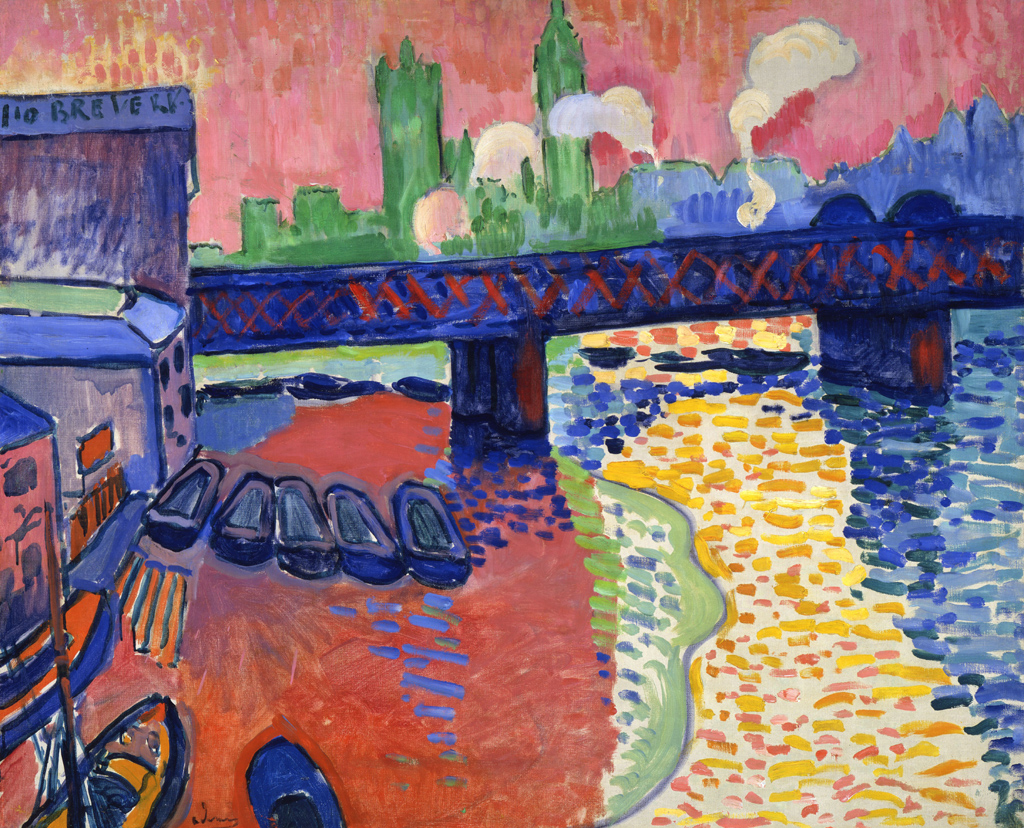
One of the dominant movements in painting was the short-lived Fauvism, the art of wild beasts. Henri Matisse and Andre Derain were the main names in this movement, with many of their paintings from the 1905-1908 period selling for millions or being retained in museums today.** For example, Derain's Charing Cross Bridge (1905) was displayed at the Salon d'Automne in 1905:

Andre Derain, Charing Cross Bridge, 1905. Image from Wikipedia.

McAuliffe's focus is usually on artistic and social movements, so reading about World War I picked my attention right back up after so many pages on the few years preceding it. McAuliffe follows Charles De Gaulle from his childhood early in the book until his days as a captain during World War I, impressing his superiors by advocating for aggressive battlefield tactics. De Gaulle's most notable adventure, though, happens after his capture by German forces. His multiple prison escapes are worthy of an action movie; one escape in Bavaria, when De Gaulle escaped by hiding in a laundry basket, has decidedly The Count of Monte Cristo feel.

Although McAuliffe makes the reader yearn for the Belle Epoque, Midnight in Paris-style, she turns 180 degrees on the very last page. She points out that for Paris's poor, the Belle Epoque was a miserable time; (350) the biographies of some of her selected celebrities who fell into poverty echo this sentiment. Melies, the great filmmaker, lost almost all of his money when his master tapes were melted for their metal content during World War I. He shifted occupations, shockingly, to owning a candy and toy store. (332-333) Picasso had to wait until 1909 to rent a large, clean apartment with a maid (178), nine years after disembarking the train on the opening page, after his Blue Period had already ended and Cubism was underway. The Belle Epoque could be as dazzling as the 1912 Paris social scene's "new standard for reckless extravagance" (229) or as horrifying as the war that Edith Wharton, referring to German actions in Belgium, called a "hideous flood of savagery". (277) The ominous feeling for the reader of knowing how soon World War I will occur, while the characters have no way of knowing, makes each chapter feel precious. With each chapter covering roughly a year, time is limited by the physical pages of the book.

Ease of Reading: 4
Educational Content: 8


*Footage is on YouTube.

**Matisse's Femme assise sue on balcon (a non-Fauvist painting) could only fetch $3 million CAD earlier this year, which was below the consignor's reserve price, so the painting did not sell. Prognosticators estimated the painting to fetch $3.8-$5.8 million earlier that week.

Happy Canada Day from Silent Lake

Happy Canada Day 2019!

I've posted on Canada Day here before, but this time, I have pictures of a dragonfly, my dog Ory, and the water, all from beautiful Silent Lake Provincial Park in Southern Ontario:


Happy Canada Day!

NOTE: Famed Vancouver photographer Suzanne Rushton saw my dragonfly pictures and informed me that there's apparently a subculture of "macro insects" photography. I am now a member!

Tuesday, June 25, 2019

I've passed 1,000 followers on Quora!

My online presence isn't limited to this blog. In fact, it's quite extensive, and has only been growing since that archaic linked post. My biggest platform, though, is Quora.

Here's my Quora profile: https://www.quora.com/profile/Matthew-Gordon-7


Complete with 2014 profile picture, NBA answers, and various facts about me.

1,003: it's more than 1,000!

Friday, June 21, 2019

Spark

In the spirit of my extremely occasional posts on here about apps I've downloaded, a few months ago I downloaded an app called Spark. In short, it's a text-based game that requires you, a single-celled organism, to build as much influence as you can through exploiting the resources Matter, Energy, Structure, Time, Space and Spirit. The resources double, triple or more in value when you spend influence to amass them, and you also gain knowledge that carries forward each time you destroy the universe.

Along your spark's journey to mastery, there are Evolutions. Intelligence, Consciousness, Purpose, Nebulae, Star Formation, and so on lead you to greatness.

The Spark Wiki explains the app at least as well as I can:
Spark is an Idle game that was both developed and published by Deuski Games. In Spark, you take on the role of a Spark of Life that suddenly pops into existence and begins to blindly accumulate Matter into itself, thereby growing its influence on the Cosmos. The gameplay of Spark is in the classic style of idle games, where the user interface consists solely of buttons, progress bars, and timers. The game begins as simply as possible, with only one Resource (Matter) available to you, but you will quickly be prompted to swipe left to the Evolution page, where permanent improvements can be unlocked, which include more resources, auto-incrementing (even while the app is closed), an additional Upgrades menu, a reset mechanic, and more! The goal of the game is to amass as much Influence as possible and build the Cosmos in your own image!
The Wiki contains sections on most of the app's major functions, such as the aforementioned Resources, Upgrades, Evolutions, Universe Destruction, and Knowledge.

Spark has a special feature called Epochal Moments. They occur due to total influence acquired over the life of the game, meaning spending influence on upgrades does not affect when they occur. These Epochal Moments also make the game even more science fiction than it already sounds.

For fans of Spark, or for those seriously considering playing, here is the full list of Epochal Moments, which I transcribed during a GO train ride:
You exist. You are not aware that you exist because you are not aware. Instinctively, you draw nearby particulate matter to yourself. You synthesize it, and your influence begins to grow. 
You gather more matter to yourself, and you begin to do so more efficiently. The more influence you obtain, the more complex you become, and the quicker you grow. 
The patterns within you grow ever more complex, loops within loops. They blend and meld into one another. As the biggest and most complex of the systems envelops the others, you experience your first thought: “I am”. 
As your influence grows, a voice reaches into your thoughts. It suggests you heed the wisdom of those who came before you. 
Your influences grows without bound, yet you feel increasingly adrift. You reach out to the space around you and begin to organize; stars, planets, and galaxies form., and though all you see is good, you do not feel satisfied. 
As you drift through the cosmos, you notice one planet among billions that is covered in strange molecules, more complex and more varied than you have seen before. They have no Spark, no life, but nevertheless you take special watch of this planet as the eons creep by. 
Upon barren rocks patterns begin to take form. Small at first they grow more numerous and more intricate; some fall by the wayside while others grow ever larger in the slow unconquerable process of evolution, guided by your hand. 
You find the individual cells grow faster when they band together as a single unit. Over countless eons they specialize and change until none can survive isolated from the others. 
After eons of painstaking incremental change, the life you have created and nurtured experiences its first taste of self-awareness. Consciousness at long last has been given physical form. 
The conscious life you have created takes its first cautious steps out of infancy. It learns and adapts to its surroundings at a rate that has never been seen before as the individuals teach themselves to craft tools and pass that information across generations. 
The life you have created expands and builds great societies as this world has never before known. They craft ever more impressive machines, they wage war, they look out and ponder, and they continue to grow. 
The life you have created is not content to be confined to the planet it was born on. Though tentative at first, the species begins to leave on shuttles of their own design and populate other worlds. 
The life you have nurtured for so long travels and colonizes other worlds. Occasionally they meet others that are like themselves. They share technology and history, and learn from one another. The petty wars that plagued their past are now a distant memory. You look upon them and are pleased. 
Conscious life spreads rapidly throughout the Cosmos, building an astounding society that spans galaxies. Their technology continues to improve, each individual now has power that would have had them considered a god in previous eras. You watch as they continue to expand. 
The conscious life grows ever more introspective even as it continues to expand. Their understanding of the Cosmos is unparalleled, but they still marvel at why they exist, and wonder what could be their purpose. In the back of their minds they mull over this question and continue to expand. 
The conscious life, these sapiens, realize they cannot be bound to their forms forever. Like all things physical, their bodies will begin to decay. The brightest among them will gather together, and begin to work on a solution. 
The life you have created has devised a way to shed their physical form; all at once they leave their plane and join as one, a being not unlike yourself, though it is a mere shade compared to your current form. You craft a universe in which it can dwell. It instinctively reaches out and its influence begins to grow. 
These new, more intelligent beings form tightly knit packs, and they are capable of organizing and communicating commands more complex than any of their ancestors. Though the accomplishment is great, their minds are still not in your image; they are incapable of self-reflection. 
The life continues to fill the many niches present in the planet, and the simple presence of life creates new niches that are then filled by new organisms that would never have been possible in the earlier days of this wondrous experiment. 
The Great Societies of these sapient beings have grown powerful enough to destroy their world many times over. Tension fills the hearts and minds of every one of the planet’s inhabitants, and though they may be on the brink of self-extinction, they continue with their lives and continue to grow. 
The beings have reconciled with each other, and have formed a unified society that is no longer beholden to the boundaries of the past. Their resources are plentiful, and as their understanding of their place in the Cosmos continues to grow, they begin to look at the stars. 
A vast and wonderful variety of life now populates the planet you came to all those ages ago. Anywhere it is possible to survive, something finds a way to do it. Some of the life sustains itself from the energy of the nearby star, others live by consuming that life while avoiding being consumed by others. The pressure to survive continually pushes these creatures to adapt and change, and many among them grow ever more complex. 
In the struggle to survive, new strategies emerge. Creatures dart and dodge, outsmarting would-be predators. Their intelligence increases, and though the energy demands of larger brains are great, the ability to synthesize and react to new information ensures their survival. You grow vested in these creatures and begin to guide their evolution, cultivating their mental abilities.
Weird fact about the above: all 23 Epochal Moments combine to equal exactly 975 words. If there's an under 1,000 word transcription contest out there focusing on intergalactic apps, this has to win.

Thoughts on this version of how the universe progresses?

Thursday, June 20, 2019

A Timeline of a Norwegian Town's Lack of Time

If you've been following Norwegian clock news lately, surely, you've encountered one northern Norwegian man's quest to abolish time. His town is enamored with the idea, and now it's apparently being tabled - less than two days after his proposal made international news. For a group of people opposed to living life by the clock, this is awfully fast.

June 18, 3:42PM EST (8:42PM GMT): 'Don't let the clock lead us,' says Norwegian man seeking to abolish time -National Post


The progression in the titles from these outlets is astounding. From one inspiring man, to wanting to abolish time, to campaigning for it, to apparently having abolished it in the past tense (the Guardian article mentions an upcoming vote, though).

The gist of the time abolition campaign is in two key paragraphs of the Post article above:
Time also passes slowly in the Arctic Ocean, off the northern coast of Norway, when you are floating on a small boat under the bright evening sun, which is where the National Post on Monday reached Kjell Ove Hveding, a retired businessman who is actively working to abolish time in his home town of Sommaroy, a little fishing village of 300 souls. [The Guardian article above places the population at 350 and places the slash in the second O of Sommarøy.]
...
Stores will open when the staff is there, and close at other times. Schools will be flexible. Deadlines will be negotiable. Restaurant reservations will be tricky to manage, but tourists will be encouraged to move at their own pace. Importantly, there will be no clocks. Already, a poignant tribute of abandoned watches has spontaneously appeared on the railing of a local bridge.
For what seems so simple (think of any time you've been in a shower or bath on a weekend and lost track of time), it's so multi-layered:

  • Timing everything is a product of the Industrial Revolution. However, sunrise and sunset were key determinants of time in pre-Industrial societies. In northern Norway, as Hveding notes, light and darkness are seasonal. Here, according to the Sky News article above, "Sommaroy, north of the Arctic Circle, experiences a period of 69 days every year when the sun doesn't set - and this, according to the locals, is why the area should be considered a time-free zone."
  • This initiative is largely based on the idea that people are too attached to time, and should therefore break free from it. This would presumably lower stress levels. According to the Guardian article above, "In many cases this [stress and depression] can be linked to the feeling of being trapped by the clock."
The idea is admirable. However, I've already identified a few problems:
  • Stores only being open when staff are there works fine in a localized area, where walking home only to try to go to the store again in a couple hours can be workable. How can this concept ever be ported to a larger geographical area, though? That half-hour drive to Costco suddenly makes a lot less sense when Costco could be arbitrarily closed.
  • Although I eat when I'm hungry most days anyway, eating only when you're hungry could lead to substantially fewer family dinners or, similarly, meals out with friends. Alternatively, there's the risk of showing up and being the only one who's really hungry.
  • Abandoning clocks and watches must presumably also mean abandoning other timers. Otherwise, people would have the ability to tell time, which defeats the psychological purpose of living outside of time.
    • Abandoning stopwatches eliminates any chance that residents of Sommarøy ever had at being competitive in the 100-metre dash.
    • Abandoning oven timers reverts residents to the older "cook until done" model.
    • Microwaves would all have to have their timers blacked out, possibly by such low-tech means as placing duct tape or electrical tape over the timer. Toaster ovens, which usually require turning the knob to a set time, would be unworkable.
    • Sports would all have to be played to a set number of points, or be played in innings like baseball. One can only guess what would happen to basketball's shot clock.

I'd love to visit a place without time for a week or so. Should I instead visit until I feel like leaving?